 By Leo Macapagal, PTRP
Most of our knee patients in Makati tell us the same thing: "Gusto ko mag-exercise, kaso wala akong pera sa gym, at wala akong lugar." Fair. Manila condos are tight, and after a long commute, the last thing anyone wants is to go back outside to a fitness center. The good news is that knee rehab does not need equipment. It needs consistency. Five minutes in the morning, five minutes before bed — that is enough to move most stiff knees from "cranky" to "cooperative" within three to four weeks.
Before you start, two rules. One: if any exercise below causes sharp pain (not a stretch feeling — sharp, catching, locking), stop. Dull discomfort is normal; sharp is a signal to rest and book an assessment. Two: if you have recent surgery, a torn ligament, or severe swelling, check with your PT first. This routine is designed for stiff, overused, early-osteoarthritis knees — the most common kind we see.
Exercise 1: Seated leg extensions
What it does: Strengthens the quadriceps — the muscle above your kneecap that absorbs impact when you walk. Weak quads are behind most Filipino knee complaints over 40.
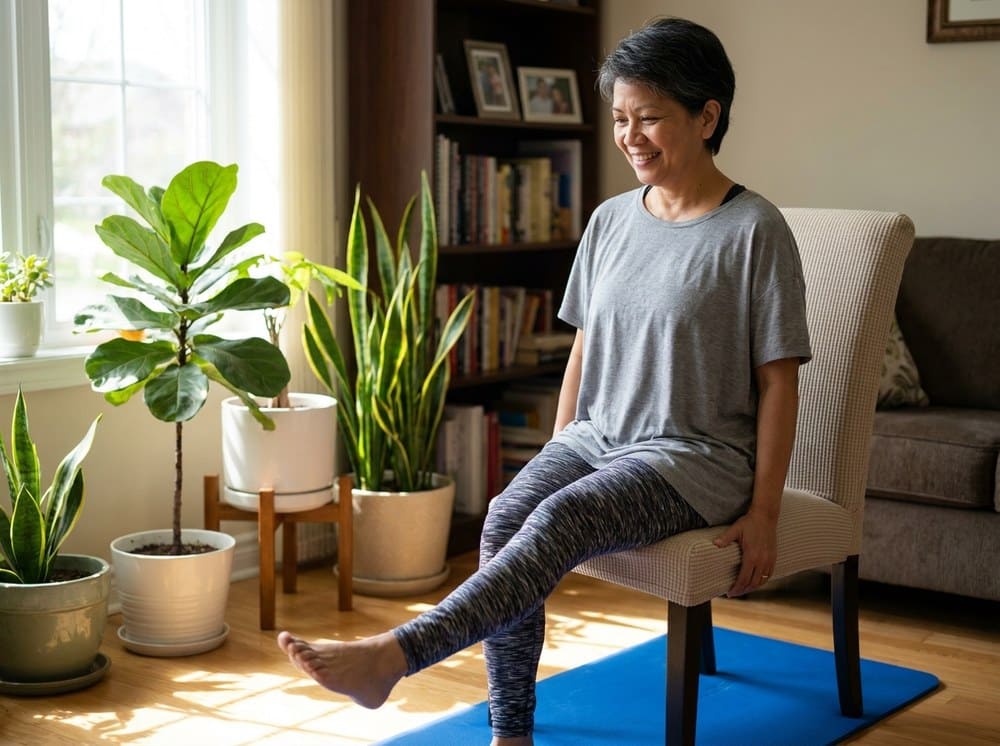
How to do it: Sit on your sturdiest dining chair, feet flat on the floor. Slowly straighten your right leg until it is parallel to the floor. Hold for 3 seconds. Lower slowly. That is one rep.
Reps: 10 per leg, 2 sets. Do this while waiting for your kape or during a Zoom meeting with the camera off.
Why this one first
It builds baseline quad strength without putting any weight on the knee. Perfect for people who feel pain when they try to squat or lunge right away.
Exercise 2: Wall sit (short hold)
What it does: Builds quadriceps and glute endurance — the foundation of stair climbing, getting up from chairs, and not wobbling when you carry groceries.
How to do it: Stand with your back flat against a wall. Slide down until your knees are bent about 45 degrees (not a full 90 — that is too much for most stiff knees). Hold.
Time: 20 seconds to start, working up to 45 seconds. Repeat 3 times. If you feel pain in the front of your knee, come higher up the wall — reduce the bend.
Tip from our team
Most condo walls in Manila have wallpaper or paint that marks easily. Place a small hand towel behind your back before sliding down. Sweat is real in this climate — no one wants to explain a damp wall mark to the kasambahay later.
Exercise 3: Standing hamstring curls
What it does: Works the muscles at the back of your thigh. Tight, weak hamstrings pull on the knee joint and contribute to the "my knees feel heavy" sensation.
How to do it: Stand behind a sturdy chair, hands on the chair back for balance. Lift your right heel up toward your bottom, knee pointing down. Control the motion — do not kick it. Lower slowly.
Reps: 12 per leg, 2 sets.
Bonus: this also works your balance, which tends to fade after 50 and is one of the things our senior mobility program rebuilds deliberately.
Exercise 4: Glute bridge
What it does: Activates the gluteus maximus — your biggest hip muscle. Strong glutes take load off the knees. Most desk workers in Makati have "sleeping" glutes from sitting 8 to 10 hours a day.
How to do it: Lie on your back on a mat or a folded blanket (in a condo, your living room floor is fine). Knees bent, feet flat on the floor, arms by your sides. Squeeze your bottom and lift your hips until your body forms a straight line from shoulders to knees. Hold 2 seconds. Lower slowly.
Reps: 15 per set, 2 sets.
The truth most people miss: knee pain is often a hip problem in disguise. Fix the glutes, and knees often quiet down within two weeks.
Exercise 5: Step-downs (using your condo stairs or a low step)
What it does: Trains the quadriceps eccentrically — the exact motion you use when walking down stairs or stepping off jeepneys. This is the motion most knee patients find painful, so building strength here transfers directly to daily life.
How to do it: Stand on the bottom step of your building staircase, or on a sturdy low stool about 4 to 6 inches high. Slowly lower one leg off the edge, just tapping the toes to the floor — do not put weight down. Return to standing on both feet. That is one rep.
Reps: 8 per leg, 2 sets. Keep one hand on a railing or wall for balance.
If you feel any pinching
Pinching at the front of the knee usually means your knee is collapsing inward. Focus on keeping your kneecap pointed straight forward over your middle toe. If it still pinches after three days of practice, it is worth a one-session assessment — this is exactly the detail that is easy to correct in person and hard to correct alone.
Putting it all together: a 10-minute routine
- Seated leg extensions: 10 reps each leg × 2
- Wall sit: 20–30 seconds × 3
- Standing hamstring curls: 12 reps each leg × 2
- Glute bridge: 15 reps × 2
- Step-downs: 8 reps each leg × 2
Done properly, this takes 9 to 11 minutes. Do it 4 to 5 times a week. In our experience, people who do this routine consistently for three weeks see a real, tangible difference in how their knees feel going up and down stairs — even in older buildings with no elevator, the kind of place a lot of Makati residents know well.
When home exercises are not enough
Home routines work brilliantly for stiff, overused, and mildly arthritic knees. They do not work well for torn ligaments, advanced osteoarthritis, or post-surgical knees that need progressive loading. If you have been consistent for four weeks and you feel no improvement — or worse, more pain — that is a signal to come in. Our full knee and arthritis care program picks up exactly where home exercise stops working. If you want a broader read on why joints flare up in our climate, start with managing joint pain in humid Manila.
Kumusta ka after three weeks of this routine? Tell us at your assessment. We love seeing patients who have already done the work — it means we can push the program faster and get you back to full function sooner.