 By Fely Santiago, PTRP
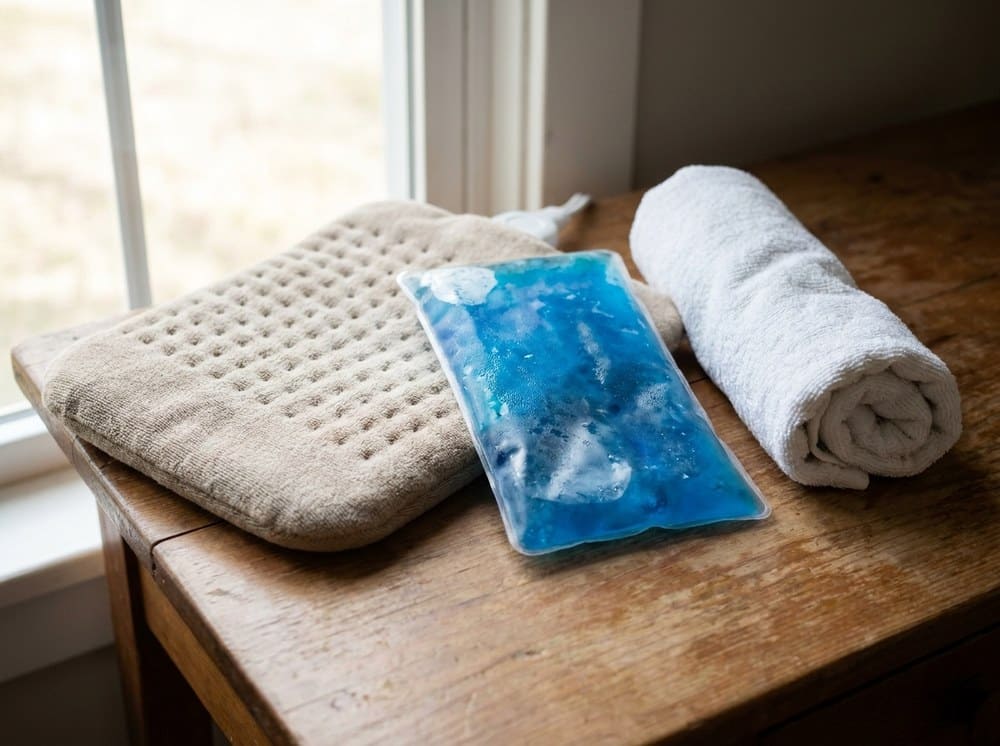
One of the questions I get most often from patients — and from my own tita — is "dapat ba ice o hot compress?" It is a fair question, because even within the PT community the answer has evolved over the last decade. The older "ice everything for 48 hours" rule has been softened by new research. Here is the 2026 version, made practical for Filipino homes.
The short decision chart
If I had to put it on a napkin, it would read:
- Fresh injury, obvious swelling, first 48 hours → brief ice.
- Stiff, achy, chronic muscle tension, no swelling → heat.
- Sharp, stabbing, or electric nerve pain → probably neither; see a clinician.
- Severe or unexplained swelling, redness, or warmth → see a doctor before applying anything.
That covers maybe 80% of cases. The interesting 20% is everything else, which is what the rest of this article is for.
When ice actually helps
Ice — or more broadly, cold therapy — is useful for a specific biological purpose: reducing acute inflammation and numbing pain in tissue that has just been hurt. Its best use cases are:
- The first 24 to 48 hours after an ankle sprain, muscle strain, or bumped-shin-level injury.
- Post-surgical swelling (following your surgeon's instructions).
- Acute flares of certain forms of arthritis, when the joint is visibly warm and swollen.
- Short-term pain numbing before a movement you know is going to hurt (applied 10 minutes, then move).
How to use it: ice wrapped in a thin towel (never direct on bare skin), applied 15 to 20 minutes at a time, with at least an hour between applications. Elevate the injured area while icing. Stop earlier if the skin becomes numb or very red.
What has changed: older advice was "RICE" (Rest, Ice, Compression, Elevation). Current research suggests that after the first 48 hours, icing too much can actually slow the healing process because inflammation is part of how the body repairs tissue. So — ice in the first two days, then back off and start gentle movement.
When heat actually helps
Heat is almost the opposite of ice in its mechanism. It increases local blood flow, relaxes muscle fibers, and reduces the perception of pain through different neural pathways. Best use cases:
- Chronic muscle tension — tight neck, stiff shoulders, cranky lower back after commute.
- "Tightness" more than "inflammation" — that deep ache from being hunched all day.
- Period pain (for many people).
- Before gentle stretching or a walk, to loosen things up.
- Morning stiffness of osteoarthritis (not during a hot flare, but to ease that first-movement creakiness).
How to use it: a warm — not scalding — hot pack, hot water bottle, or hot shower for 15 to 20 minutes. Moist heat (a towel dipped in hot water and wrung out) is often more effective than dry heat. Always test against your forearm first before applying to a tender area.
Tip from our team
Never fall asleep on a heating pad or hot water bottle. We see patients at our clinic every year with deep burns from overnight heating — sometimes serious enough to need hospital care. If drowsiness is a risk, set a timer.
Filipino home remedies: what holds up and what does not
Several popular local remedies are forms of heat or counter-irritation therapy. A quick reality check:
- Menthol liniment (Efficascent, White Flower, Katinko) — these create a cooling sensation followed by a warming one, which gates pain signals at the skin level. For minor muscle aches they work fine. They do not "draw out" anything or heal the underlying tissue — they just feel good, which is still useful.
- Tiger balm / omega oil — similar principle, broadly safe for external use on muscle aches. Do not use on broken skin.
- Hot compress with salt or herbs — the heat is the active ingredient. The salt/herbs add scent and tradition, not additional medical benefit. Fine to use, not a cure.
- Hilot massage — can be very pleasant and relaxing, but deep "bone cracking" hilot is not recommended for acute injuries. If the person has trained in PT or sports massage, more appropriate for chronic tension.
- Ice from the freezer right on the skin — common, but risks frostbite. Always wrap in cloth.
Why "tropical humidity" changes the calculus a little
Here is something most international advice does not account for: we live in a hot, humid country. Heat therapy on a 34-degree April afternoon in a condo without AC may not be what your body wants, even if the pain is chronic. On those days, a cool shower followed by gentle movement often does more good than a traditional hot compress. We also see more ice tolerance issues in Baguio and Tagaytay clients during cold months. Common sense matters.
Conditions where people often choose wrong
Acute lower back spasm after lifting something heavy
People often reach for heat, because the area is stiff. But if this was a clear sudden injury with a "pop" feeling, an initial brief period of ice may be better, followed by gentle movement. After 24 to 48 hours, heat is fine. For more on back pain approaches, see our lower back pain article for Manila commuters.
"Tulog mali" (slept wrong) neck pain
This is usually muscular, not a fresh injury. Heat plus gentle range-of-motion movement works better than ice. See our WFH neck and shoulder guide for related stretches.
Knee osteoarthritis
Morning stiffness — heat. A flare where the knee feels hot and swollen — ice. The distinction matters, and part of our knee and arthritis care program is teaching patients to read which flavor of pain they are having.
Tendon pain (tennis elbow, Achilles, patellar)
Ice gives short-term relief but does little for the underlying tendon problem. Heat can help during warm-up. The real fix for tendons is graded loading exercise — neither temperature therapy alone will cut it.
Pro tip: "contrast therapy" — alternating 3 minutes heat, 1 minute ice, repeated 3 to 5 times — is popular with athletes. The evidence is mixed at best, but some patients genuinely like it for post-activity recovery. Not harmful, not magic.
When neither works (and why)
If pain has been going for more than 2 to 3 weeks and neither heat nor ice is making a dent, you have moved into territory where these modalities are not going to solve the problem. Common reasons:
- The pain is nerve-origin — true radicular pain down a leg or arm rarely responds to temperature therapy.
- The pain is chronic and centrally sensitized — see our chronic pain article for why the nervous system plays a bigger role than tissue at this stage.
- There is a structural issue needing assessment — a torn meniscus, a herniated disc, a frozen shoulder. Temperature helps the symptoms; it does not repair the tissue.
- There is systemic inflammation — inflammatory arthritis, gout — needing medical rather than mechanical treatment.
This is where a proper physical therapy assessment earns its keep. We will figure out whether the issue is tissue, nerve, movement pattern, or a mix, and build an actual plan.
Red flags: do not just ice and wait
See a doctor, not a physiotherapist, if you have:
- Significant swelling after a fall (possible fracture).
- Sudden, severe, unexplained joint swelling with heat and redness.
- Fever along with joint pain.
- Calf pain with warmth or swelling (possible blood clot — treat as urgent).
- Loss of bowel or bladder control along with back pain (emergency).
- Numbness or weakness spreading to a limb.
The bottom line
Heat and ice are useful tools, especially in the first 48 hours of an acute issue and for everyday muscular tension. Beyond that, they are supporting actors, not the main character. If you find yourself reaching for the hot compress three times a week and not getting better, the answer probably is not more heat — it is a proper look at what is actually going on.
Pain that is not responding to home remedies?
Book a free 20-minute assessment. We will check the mechanics, tell you honestly whether this is a home-remedy problem or a bigger one, and map out the next steps.
Book Assessment Call +63 917 428 6391